Softshell vs. hardshell roof tents: what are the real differences?
Anyone looking to buy a roof tent will soon be faced with the same choice: softshell or hardshell? Online, you will often find strong opinions and half-truths, but in practice, the differences are less black and white. Both types have their strengths, but they suit completely different ways of travelling. In this article, we list the differences honestly and clearly, so that you know exactly which roof tent suits your car, your travel behaviour and your expectations.
1. Softshell and hardshell: what is the real difference?
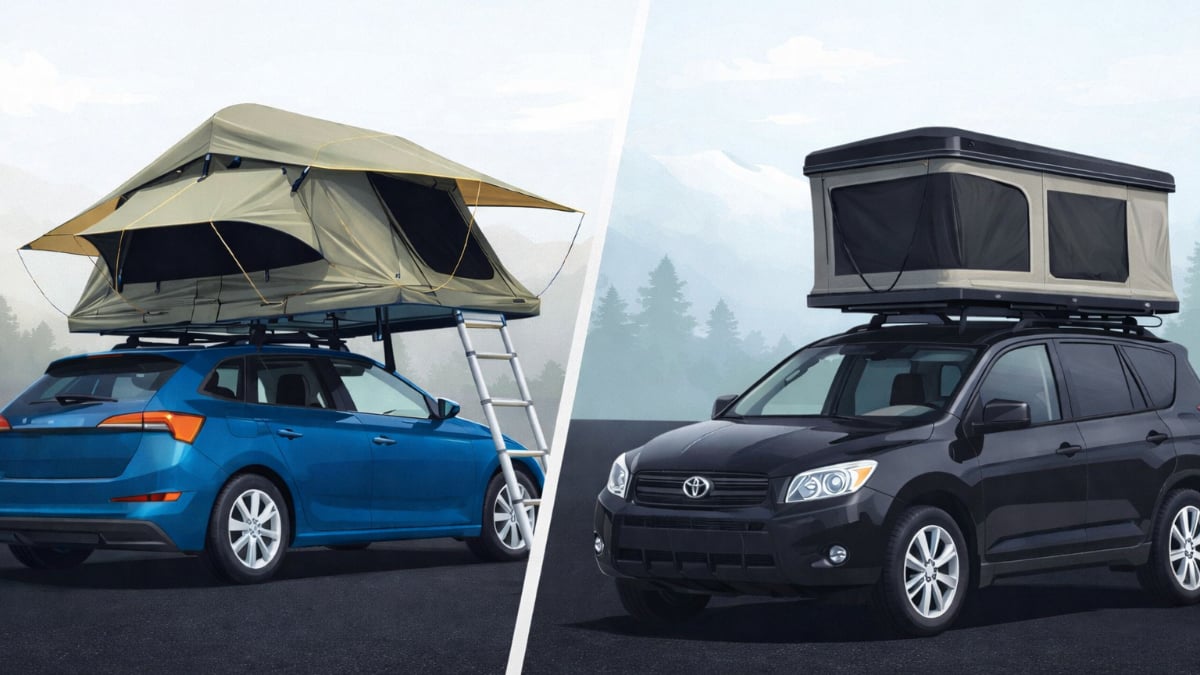
Softshell roof tents fold out to form a spacious sleeping area with plenty of headroom and a wide base plate. They generally offer more living space and are popular among travellers who value comfort, space and expandability.
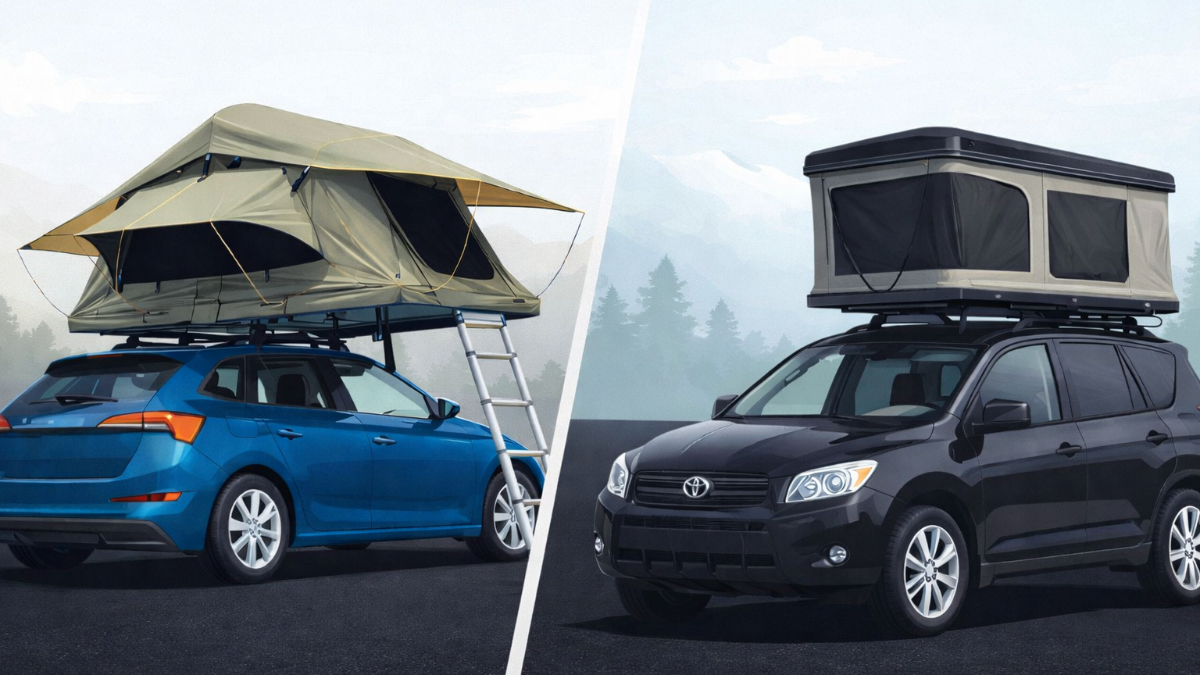
Hardshell roof tents have a hard case that hinges upwards or forwards. They look sleek, are compact and quick to set up.
An important point that is often overlooked:
In softshell roof tents, bedding can almost always remain in place when folding down the tent.
This is also possible with many hardshells, provided that the shell is high enough.
However:
👉 With thinner hardshells, the housing is simply too flat to store bedding, pillows or a duvet.
Everything has to be taken out of the tent and put in the car. In practice, this makes a big difference, especially on long journeys.
2. Ease of setup: the difference is smaller than you think
Hardshells are slightly quicker to set up — that's for sure. You unlock the fasteners, give them a push, and the gas springs do the rest. Then, just like with softshells, you can choose whether to extend the awnings using the supplied window poles or awning poles.
But with modern softshells, it's also very simple:
-
Loosen the cover and remove it from the tent.
-
Pull out the ladder
-
Use the ladder to open the tent.
-
Place the supplied bow stick or window braces above the entrance.
-
Now you can choose to extend the awnings using the supplied window poles or awning poles.
These steps may sound like they take longer, but it's still a process that takes only a few minutes.
In practice, the difference between softshell and hardshell is often one minute, sometimes even less.
For most travellers, this small difference doesn't matter.
The real choice lies in what else is important to you: space, weight, expandability and storage.
3. Weight and roof load: there is an important difference here
Hardshell roof tents are noticeably heavier due to their box construction. This has direct consequences:
-
your car must be able to handle a higher dynamic load capacity
-
your roof racks must be able to carry heavier loads
-
compact SUVs and passenger cars are sometimes not suitable
-
Softshells are lighter and therefore fit on many more vehicles.
If you have a car with a lower roof load, you will automatically end up with a softshell.
The difference in weight sometimes determines more than taste or appearance.
4. Space, comfort and sleep quality
Softshell roof tents score particularly well here. They offer:
-
more interior space
-
often a longer bed length
-
more seating space
-
more space to put things down next to you on the mattress
This is important for taller campers, because:
👉 Almost everyone sleeps with a pillow — so you automatically need more effective bed length than it seems on paper.
With hardshells, the sleeping space depends greatly on the model. Some offer excellent length and height, while others are compact and low due to their thin design. This is convenient on the car, but narrower inside.
5. Aerodynamics & fuel consumption: many misconceptions
Hardshells appear aerodynamic because they are tightly shaped. However, research and practical experience show that:
👉 There is hardly any difference in fuel consumption between softshells and hardshells.
Why?
The biggest influences are:
-
the shape of the car itself
-
the total frontal surface area
-
the roof racks
-
and the most important factor: speed
The shape of the tent plays a much smaller role than is often thought.
The supposed 'big advantage' of hardshells in this area is therefore mainly visual.
6. Expansion possibilities: softshells clearly win here
Softshell roof tents are designed for extensions. Thanks to a larger overhang, wider base plate, multiple mounting points and lower weight, you can easily:
-
connecting annexes with fully closed groundsheets
-
using sliding walls
-
adding an awning to your roof rack
-
adding side walls
-
expanding your living space for longer trips
Hardshells are much more limited due to their fixed shell:
-
fewer mounting points
-
rarely suitable for annexes with full groundsheets
-
usually only a small awning is possible
For travellers who want their setup to grow with them — now or later — the softshell is by far the most logical choice.
7. Storage & packing volume: often overlooked, but crucial
Storage space in and around the tent determines much more comfort than you think.
Softshells:
-
bedding can stay where it is
-
blankets fit easily (pillows not always)
-
small items can often be folded up and taken with you
-
less loose luggage in the car
Hardshells:
-
with many models, bedding can remain in place
-
but with thin hard cases, this is not possible → everything has to go in the car this takes up space and creates more clutter in the car
For families and long journeys, this difference is very noticeable.
8. Lifespan, maintenance & storage of your roof tent
Lifespan & maintenance
Softshell:
-
Store in a dry place.
-
Impregnation is usually only necessary after 3–4 years, often even later. The aim is to reduce water absorption and shorten drying time. The fabric and seams are waterproof.
-
Check the zips from time to time.
Hardshell:
-
Check gas springs regularly
-
Keep zips, hinges and fastenings supple
-
Check rubber seals for dirt and dryness
Storing your roof tent out of season
Many tents do not last as long due to improper storage. Here is how to do it correctly:
-
Softshells can easily be stored flat or on their side. No problem at all.
-
Hardshells are large and their lids are susceptible to scratches. It is best to store them flat. Storing hardshells on their side is only possible if you take precautions to prevent scratches.
-
Avoid damp sheds or unheated areas.
-
Wipe sand and dirt off the fabric and cover or lid before storing the tent.
-
Always store the tent completely dry.
A properly stored tent will demonstrably last for years longer.
9. Which roof tent suits your travel style?
Choose a softshell if you:
✔ When you are tall and want more interior space
✔ consider expansion options te be important
✔ travel with your family
✔ take longer holidays
✔ want flexibility for the future
✔ when you have limited storage space at home
Choose a hardshell if you:
✔ want to travel very minimally
✔ want simple operation
✔ often make short stops
✔ travel with two people
✔ need few extensions
10. Conclusion: not better or worse — just different
Softshells and hardshells are not opposites. They are built for different types of travellers.
-
Softshell = space, comfort, expandability
-
Hardshell = compact, sleek and fast
The best choice is the tent that suits your car and your way of travelling.
This comparison will tell you exactly what to look for.